When training stalls: getting past plateaus
Every cat hits a point where progress stops. Find out why, from treat value to session length to hidden pain, and use a simple checklist to get moving again.
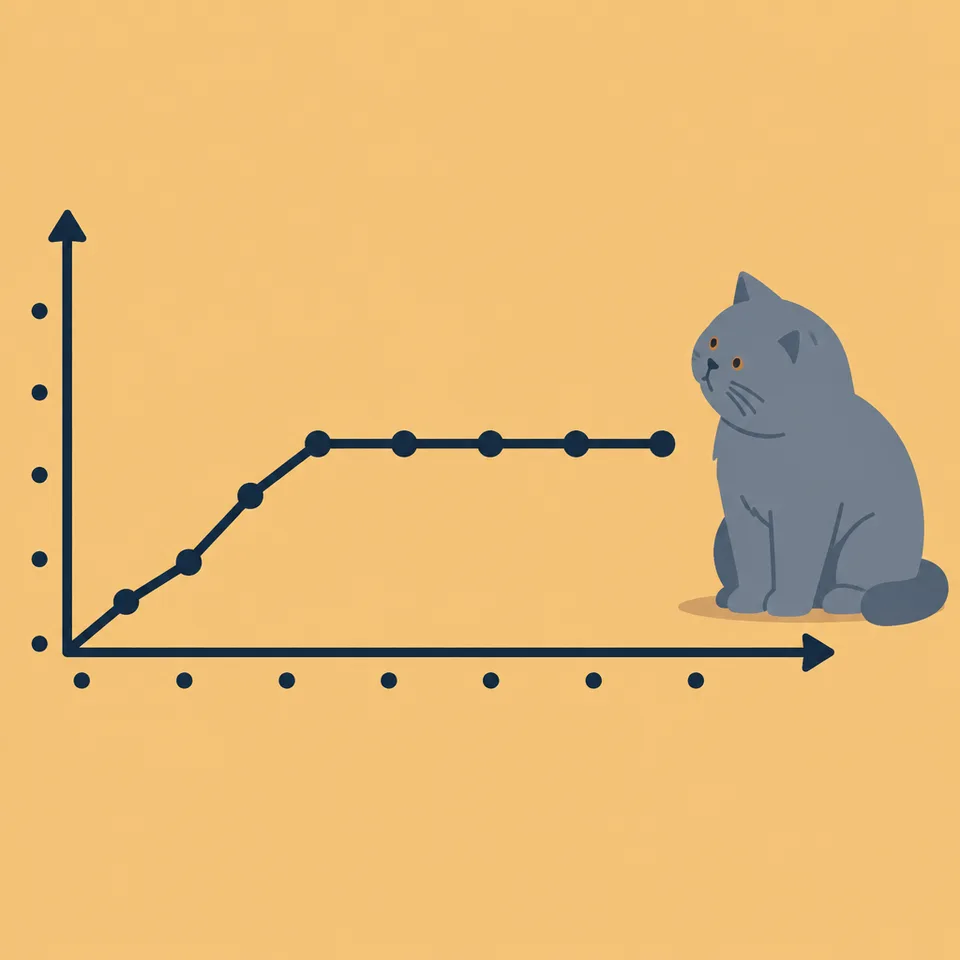
The first few lessons usually go fast. Then one day your cat stops improving, or even seems to forget something they knew. Plateaus are normal in all learning. They are almost always a sign that something about the set-up needs to change, not that your cat cannot learn.
What a plateau looks like
- Success rate stuck around half for several sessions.
- Your cat offers the old step but not the new one.
- Your cat walks off sooner than before.
- A behaviour that worked in one room falls apart in another.
- More mistakes, more staring at you, more frustration signals.
Step 1: Rule out pain and health
If a cat suddenly stops jumping onto a chair, refuses to sit, or avoids a behaviour that involves a certain movement, consider discomfort. Arthritis, dental pain and other conditions often show up first as "not wanting to" do something. Older cats, in particular, may avoid jumps and sits because they hurt. Ask your vet if you see this pattern.
Step 2: Check motivation
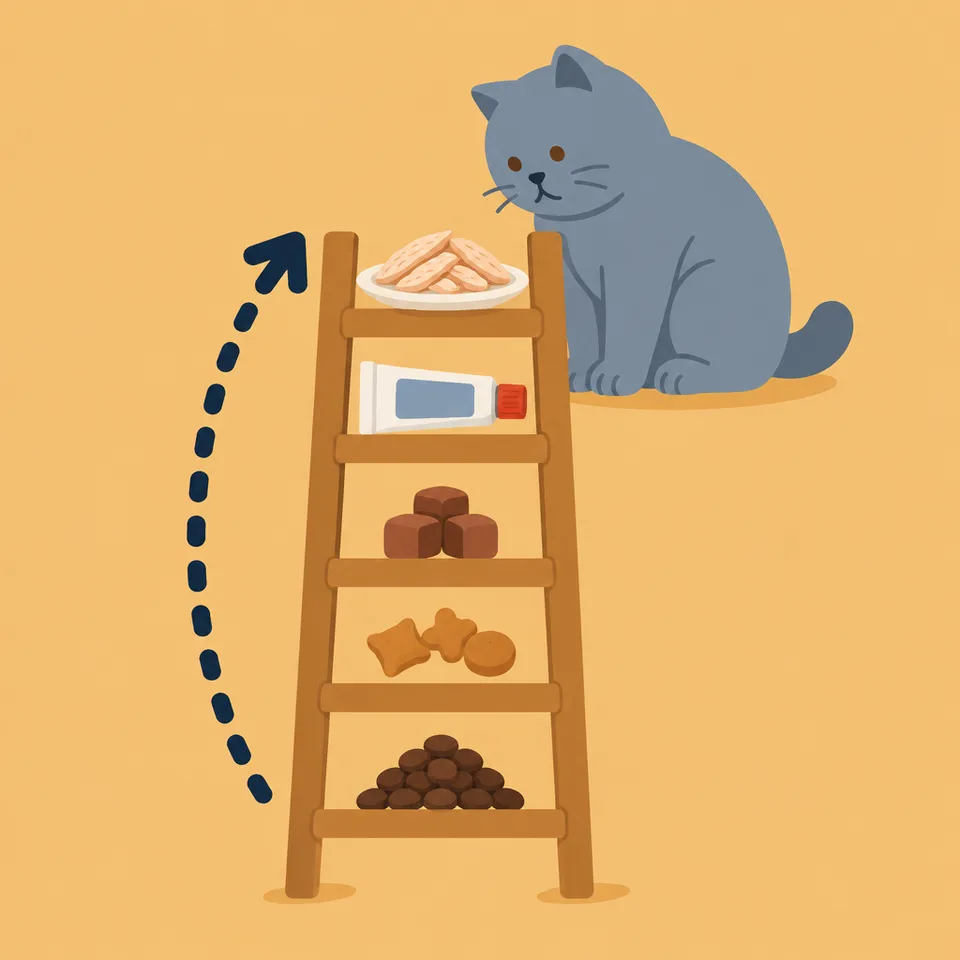
- Is the treat good enough? A treat that works in a quiet kitchen may not compete with a bird at the window. Build a treat ladder and use higher-value rewards for harder steps.
- Is your cat hungry? Train before meals, not right after.
- Is your cat full of energy? Very energetic cats may need a short play session first so they can focus.
- Is your cat bored? Doing the same thing over and over is dull. Mix two or three behaviours in a session.
Step 3: Check the step size
The most common cause of a plateau is a step that is too big.
- Look at your last few sessions. Are you clicking at least once every 5 to 10 seconds? If not, the step is too hard.
- Split the step in two. If your cat will put two paws on a stool but not jump up, reward one back paw lifting, then a little weight shifted forward, then a small hop.
- Go back to the last step your cat did well, do five easy wins, then try a smaller step forward.
Step 4: Check the 3 Ds
Did you add duration, distance and distraction at the same time? Lower two of them and work on one only. A new room is a new distraction, even if it seems quiet to you.
Step 5: Check your timing and cues
- Film a session on your phone. Are you clicking at the right moment, or a little late?
- Are you moving your hands or body in a way your cat is reading as part of the cue? Cats watch body language closely. A lure that faded too fast can leave your cat confused.
- Are you repeating the cue? Say it once, then wait. If no response, make it easier.
Step 6: Check session length and frequency
- Three to five minutes is plenty. Longer sessions lead to fatigue and mistakes.
- End on a success, while your cat still wants more.
- Several short sessions spread through the day beat one long one.
- A day or two off can help. Many animals perform better after a short break, as if learning has had time to settle.
Signs of frustration
Stop and make it easier if you see:
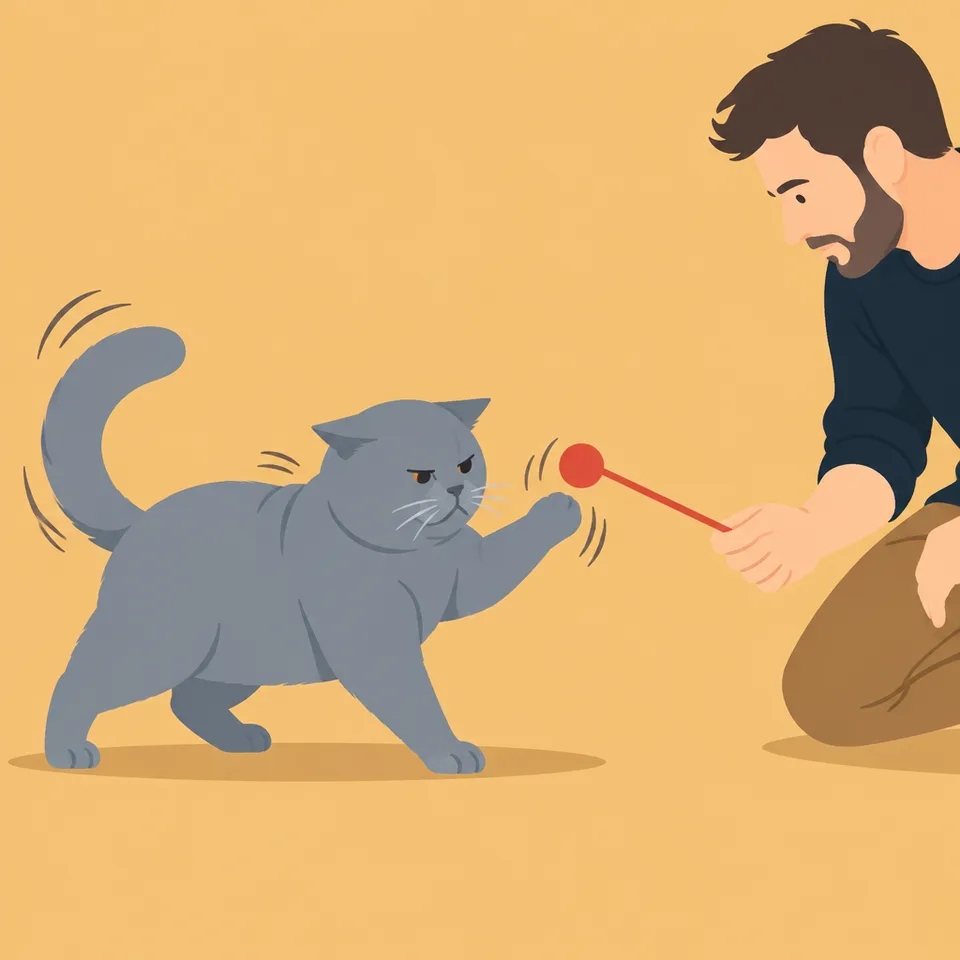
- Tail lashing or thumping.
- Ears turning sideways or back.
- Swatting at the target or your hand.
- Sudden grooming, sniffing the floor or walking away.
- Vocalising or staring hard at the treat hand.
Frustration means the rate of reward has dropped too low. Give a few easy, quick wins and finish the session.
The plateau checklist
When progress stops, go through this list before your next session:
- Any sign of pain, illness or stress at home lately?
- Is the treat good enough for this level of difficulty?
- Is my cat hungry, rested and calm?
- Am I clicking at least every 5 to 10 seconds?
- Did I raise more than one D at once?
- Is my timing on point (check a video)?
- Are sessions short and ending on a win?
- Have I had a day off recently?
When to change course
Sometimes a particular trick just is not right for a cat. A cat with stiff hips may never enjoy jumping through a high hoop. Change the behaviour to suit the cat: a lower hoop, a different trick, or a care skill that is more useful anyway. Training is meant to be fun for both of you.
Key points
- Plateaus are normal and usually mean the set-up needs adjusting, not that your cat cannot learn.
- Rule out pain first, especially if your cat avoids a specific movement.
- Most plateaus are fixed by splitting the step, raising treat value or lowering one of the 3 Ds.
- Watch for frustration signals and keep the rate of reward high.
- Short sessions, ending on a success, with occasional days off, keep progress moving.