Hunting feeder mice for cats: how to play
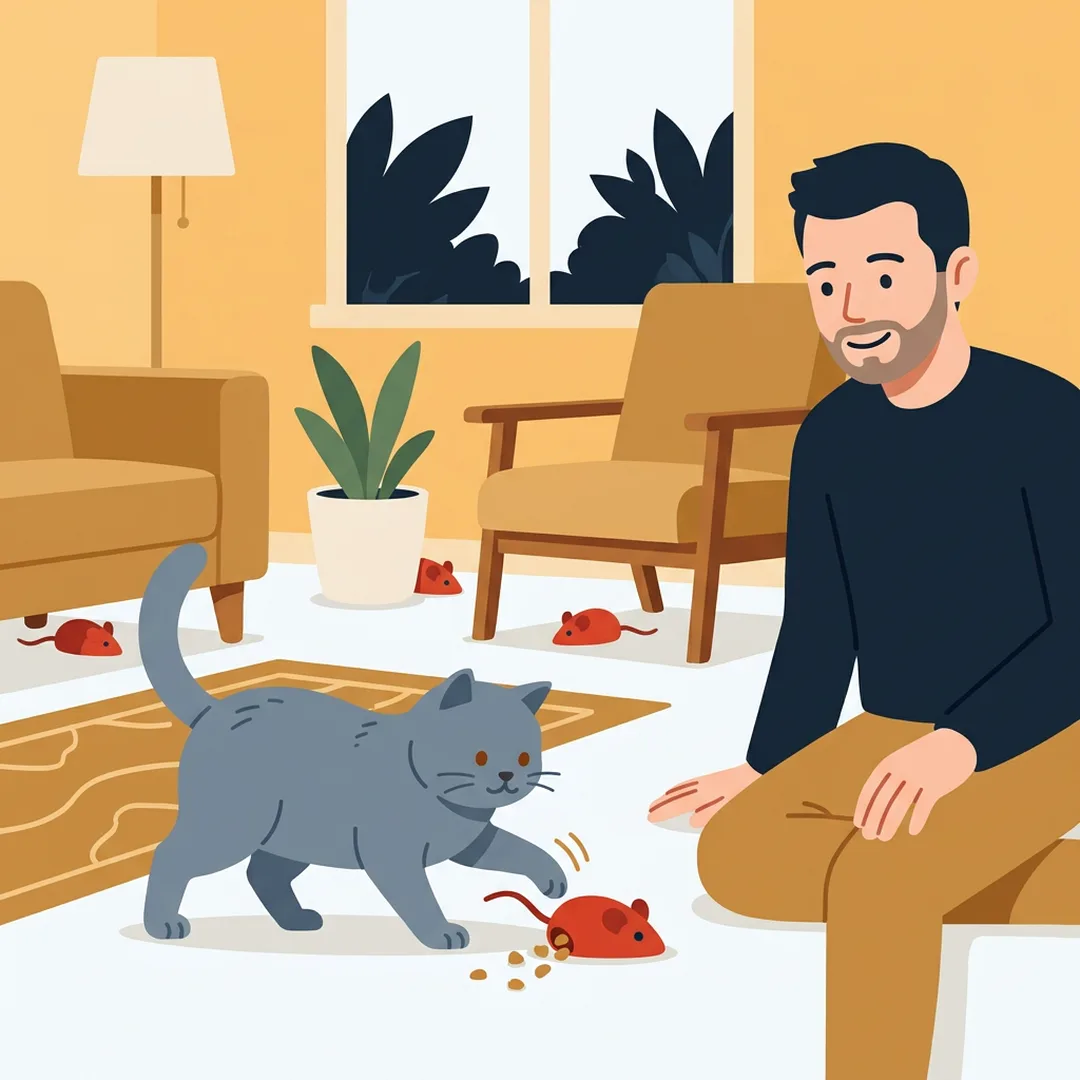
Fill small soft feeder 'mice' with portions of kibble and hide them around the home. Your cat hunts several small meals a day.
- Time
- 15 min
- Energy
- Medium
- Space
- A room
You'll need
- 2 to 5 hunting feeder toys (soft mouse-shaped feeders with a kibble pocket, or small treat balls)
- measured daily kibble
Set up
Measure your cat's daily kibble and split it between the feeders. Start by showing the feeders, not hiding them.
How to play
Fill one feeder and put it next to the usual bowl, with a little kibble scattered around it.
Roll or bat the feeder so kibble falls out. Let your cat see how it works.
Once your cat empties it on its own, place feeders in plain sight in the same room.
Then hide them: behind a door, on a low shelf, inside a box.
Hide a set in the morning and a set in the evening. Over a few weeks, they can replace the bowl for dry food.
Check every feeder was emptied. If not, make hiding easier and weigh your cat weekly.
House rules
- All food is measured first.
- Every feeder must be found and emptied by the end of the day.
- Move gradually from bowl to feeders.
- Make it easier
- Keep feeders in plain sight and leave a bowl with part of the meal.
- Make it harder
- Hide feeders in different rooms, at different heights, and change spots every day.
Signs it's having fun
Searching on its own at feeding time, batting feeders around, finishing every portion.
Stop if you see
Your cat leaves food uneaten, cries at the empty bowl, or loses weight.
Safety
 Safety
- Weigh your cat every week while switching. Any weight loss or missed meals means go back a step and talk to your vet.
- Cats should never go more than a day without eating. Not eating for 24 hours is a reason to call your vet.
- Wash feeders often.
Sources
- Study finds nearly a third of cat owners use food puzzles (UC Davis)
- Toys (Ohio State Indoor Pet Initiative)
Written from these sources and checked against vet and trainer guidance. General guidance, not veterinary advice.
Game · 10 min
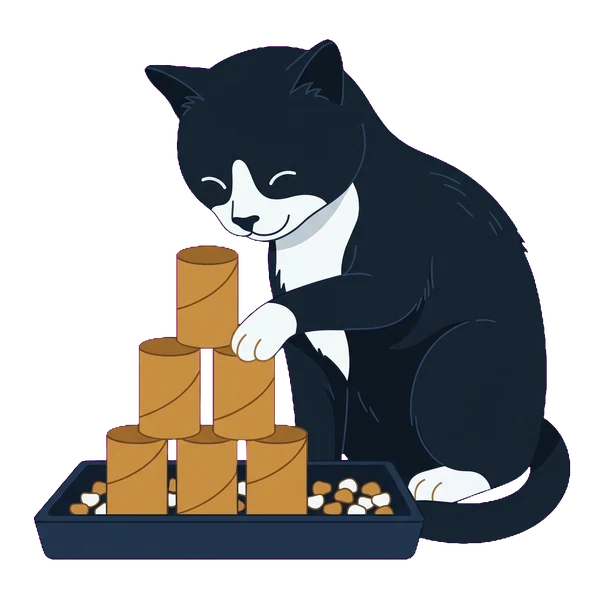
Toilet-roll pyramid for cats: how to play
Cardboard tubes stacked into a pyramid with kibble inside. Your cat fishes out food with its paws.
Game · 8 min
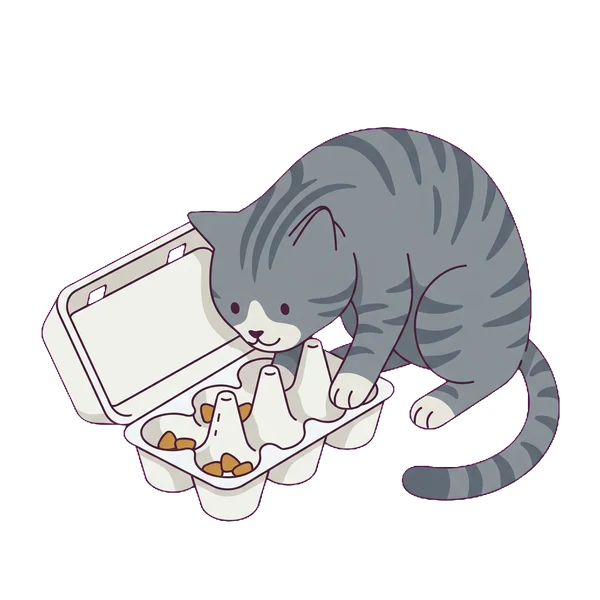
Egg-carton puzzle for cats: how to play
Kibble tucked into the cups of a paper egg carton. A gentle first puzzle for any cat.
Game · 8 min
Ice-cube tray forage for cats: how to play
Kibble or a lick of wet food in the wells of an ice-cube tray. Your cat licks and scoops each one clean.